March 2026 Newsletter

|
MONITOR
Peyton's Field Notes from the Suncoast: Three Shark Fins and a Larger Story
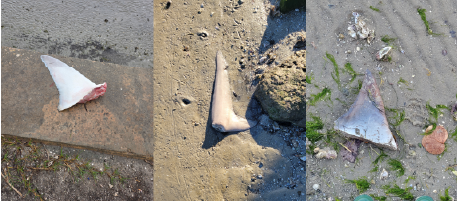
During my past year working as the Water Quality and Pollution Specialist for the South Suncoast region, I have encountered many unusual sights along my sampling route. Last November, I encountered something far more troubling: a severed shark fin left on a seawall. The sight was both confusing and upsetting. I could not understand why someone would remove a shark’s fin, causing fatal harm to the animal, only to leave it behind. Finding one fin would have been disturbing enough, but between November 2025 and January 2026, I discovered three separate fins at the same location.
Shark finning is the practice of removing a shark’s fins and discarding the body back into the water. While the animal may still be alive when released, it typically dies soon after due to blood loss, suffocation, or predation. After finding the first dorsal fin, I reached out to marine biologist Jasmin Graham, CEO of Minorities in Shark Sciences, for help identifying the species. From a photo, she confirmed it belonged to a Great Hammerhead (Sphyrna mokarran), a species listed as critically endangered on the IUCN Red List. About a week later, a second fin, a caudal fin from another Great Hammerhead, appeared at the same site. It was fresh, which suggested it came from a different shark than the fin from the week before. Then, in January, a third dorsal fin was discovered, this time from either a Bull or Sandbar shark.
I reported each incident to the Florida Fish and Wildlife Conservation Commission (FWC). Without being able to identify the person responsible, though, their enforcement options were limited. Seeking a more proactive response, we contacted a Sarasota Police Marine Patrol officer, who jumped into action, informing the unit of these incidents and helping to coordinate increased patrols in the area. Under Florida law, it is illegal to possess or land a detached shark fin, and violators can face fines and license suspension.
You may be wondering, “Why would someone do this?” Historically, sharks were finned for shark fin soup, where fins are far more valuable than the rest of the animal. Sharks as a whole have low-quality meat, which makes them less commercially important in the United States than in other countries. In this case, the fins were left behind, suggesting a different motive. “It’s hard to know exactly what’s happening here. This could be someone unaware of shark harvest regulations, or it could reflect the real frustrations many fishers are facing,” notes Jasmin Graham of MISS. “After generations without competing with sharks, we’re now in an era of declining fish stocks where both humans and sharks rely on the same limited resources. That shift comes with growing pains, but by working together, we can find ways to coexist—protecting these vital marine species while ensuring fishers can support their families and maintain economic stability.”
The reality is that we need sharks and sharks need us. Shark populations have been declining for years due to fishing pressure and habitat degradation, and only with strict, complex management have they stabilized. As apex predators, sharks play a critical role in maintaining healthy marine ecosystems. They help regulate species populations, remove weak or sick individuals, and support the balance of the food web. These checks and balances have positive impacts on ecosystems such as seagrass beds, mangroves, and coral reefs, which sustain important fish species such as tarpon, redfish, and snook.
Sharks play a vital role in the broader picture of the Suncoast we enjoy and cherish. Without them, we not only lose a crucial and charismatic member of the marine ecosystem, but we risk losing what makes the Suncoast the singular place it is.
Sources:
Casselberry, G. A., Markowitz, E. M., Alves, K., Russo, J. D., Skomal, G. B., & Danylchuk, A.J. (2021). When fishing bites: Understanding angler responses to shark depredation. Fisheries Research, 246, 106174. https://doi.org/10.1016/j.fishres.2021.106174
Fairclough, C. (2023, May 11). Shark Finning: Sharks turned Prey. Smithsonian Ocean. https://ocean.si.edu/ocean-life/sharks-rays/shark-finning-sharks-turned-prey
Motivarash, Y. B., Fofandi, D., Rehanavaz, M., & Dabhi, R. M. (2020). Importance of sharks in ocean ecosystem. ResearchGate. https://www.researchgate.net/publication/338790362_Importance_of_sharks_in_ ocean_ecosystem
INFORM
Following the Questions: Dr. Jody Harwood on Water Quality, Serendipity and Protecting Florida’s Natural Beauty
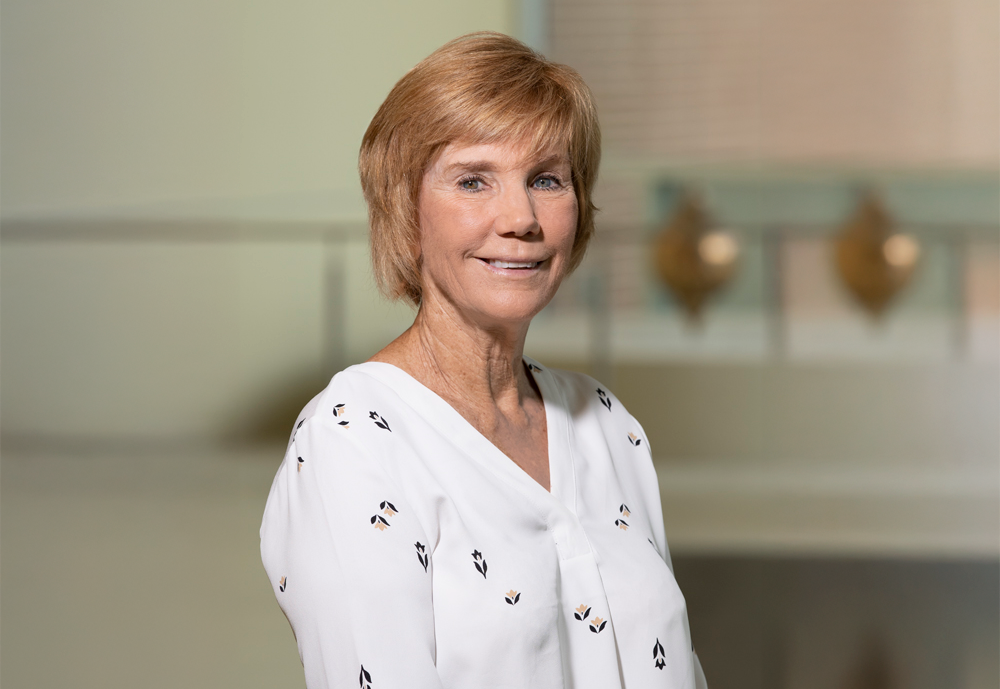
Photo by Corey Lepak
This month, Suncoast Waterkeeper launched Microbial Source Tracking (MST) at Longboat Key in partnership with Dr. Jody Harwood’s lab at the University of South Florida. In recognition of Women’s History Month, we had the opportunity to sit down with Dr. Harwood to discuss the science behind this work and the journey that led her there. In this conversation, Dr. Harwood reflects on the unexpected path that led her to microbial ecology, the role of curiosity in shaping her career, and why protecting Florida’s waters is more urgent than ever.
Interviewer: How would you describe your work in your own words?
Dr. Jody Harwood (JH): I would say that I'm a microbiologist and I work on water quality in terms of the microorganisms that are in it. I look at their ecology, and I'm interested in how they make a living in water. I'm particularly interested in viruses and bacteria that don't really belong in the water, ones that really have evolved to live in the gastrointestinal tract. What do they do when they get out in the water and how many of them survive? Why do they survive? And then how can we use them to inform us about the status of the water and where pollution is coming from?
Interviewer: You had quite a roundabout way of coming into microbial ecology. What made you want to switch career paths?
JH: That's something I always enjoy talking about because I like emphasizing the serendipity of my career. I think some people think that a career is something you decide upon early and then just stick to. But I find, in reality, there's a lot of serendipity in life. So I wanted to be a veterinarian, but in my second bachelor's degree for biology, I had a professor, Vladimir Munk and took my first microbiology course. I was completely fascinated by the idea that these tiny organisms could both kill people, animals, and plants, and that they really ran the earth and all its processes. That was mind-blowing to me.
Interviewer: What's something surprising about Florida bacteria and Florida waters that still surprises you today?
JH: Bacteria that are shed in feces and can enter the water from various contamination routes grow in the gastrointestinal tract of humans and various other animals, and yet, some of them survive really well out in the environment. We still don't have a great understanding of the genetics that allow some of these bacteria to survive. Let's just take E. coli, for example. It's a major component of your gut flora, and some strains are pathogens, while others are “naturalized”. They are able to survive and proliferate in the environment. So, we don't really understand which ones are able to do that or why. And so that's going to be an area of ongoing research in the next several decades.
Interviewer: What's something that you wish people understood better about water quality?
JH: One thing that I wish they understood, and it's linked to the second thing I'm going to say, is that almost all water that we experience on Earth is billions of years old. It was literally formed as the solar system was forming, or even before it formed. So water is precious. A very small amount is made through events that occur in modern times. So it's a very finite resource. A lot of people don't understand that.
Then that is linked to my second wish, which is that people understand that all of their activities, everything they do, impacts water quality and water availability. We're really fortunate in the US that we have ample clean water supplies. We won't always have them if we keep abusing it. So I really wish that people would think about applying fertilizers or making parking lots. Paving is one of the worst things you can do to water quality. So I just wish that we could really convey that aspect of what we do impacts this precious resource, and it is a precious resource.
|
ACT
Donor Highlight: Charles & Margery Barancik Foundation
We thank the Charles & Margery Barancik Foundation for the crucial funding of our work,
in particular our water quality program, including our Forever Free PFAS Testing program.
“We applaud the additional 31 miles of monitoring coverage and the analysis of 932 water samples this year alone. That level of scientific rigor, paired with your engagement in the Lemon Bay Watershed planning process, demonstrates how environmental science can move from collection to real influence in a community."
- Kelly Romanoff
Senior Vice President for Strategy and Evaluation
Charles & Margery Barancik Foundation
A special thank you to the following generous donor:
For a Full Listing of Our Events and Ways to Act, Visit Our Events Page.
Suncoast Curtain Call: Resilience Incubator Fundraiser

Introducing the Suncoast Curtain Call! A one-of-a-kind celebration of creativity, community, and purpose. This isn’t just a show, it’s a fundraiser supporting the Resilience Incubator, helping power local collaboration, sustainability efforts, and community-driven solutions across the Suncoast.
Join us for an afternoon of live music + performances, then stick around as the evening turns up with community karaoke at 8pm
Local eats from Simply Greek & Dave’s Neapolitan Pizza & Cash bar,
Just $10 to attend! Come out, have fun, and be part of something bigger. Tickets + sponsorships at https://givebutter.com/suncoastcurtaincall
|
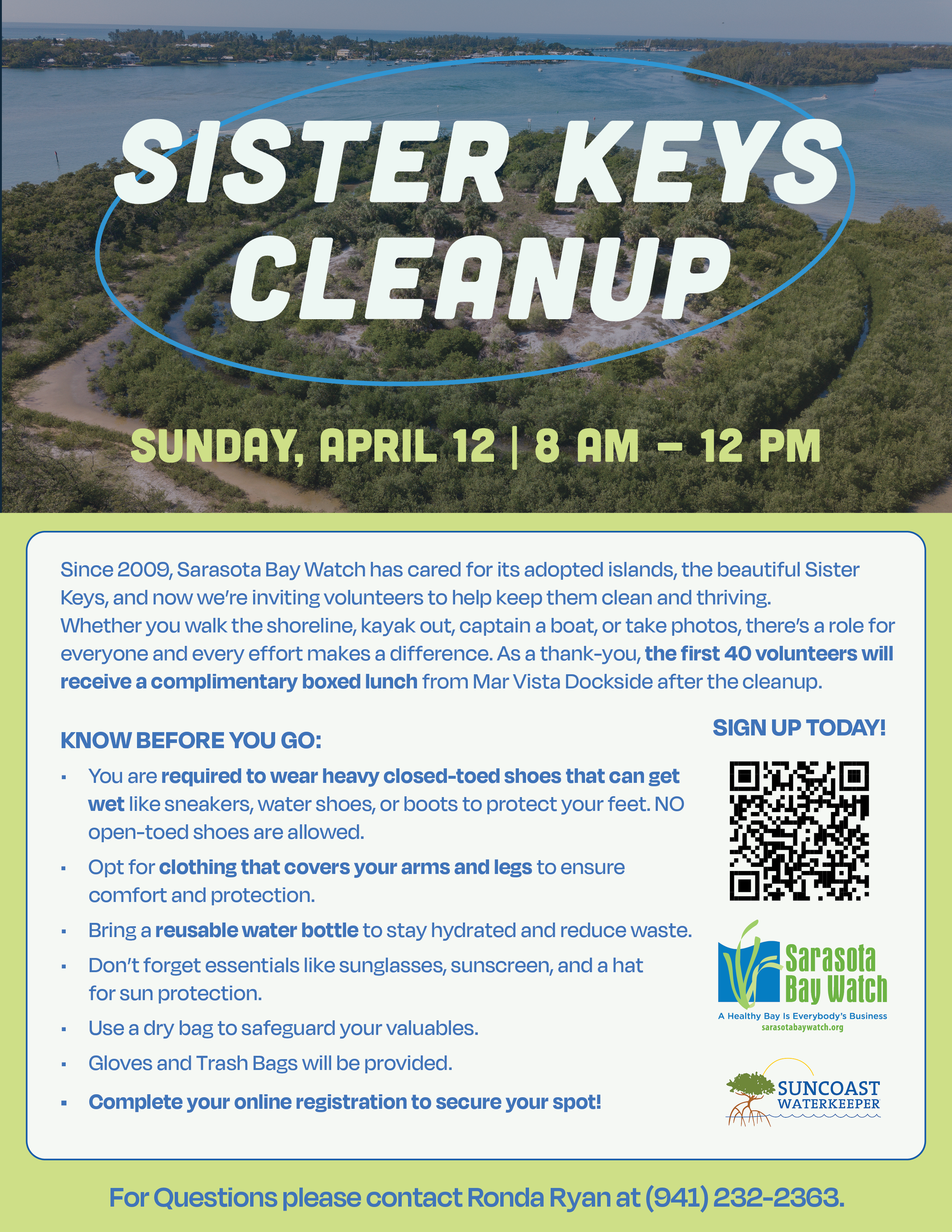
Show Some Love For Our Waters with the Sister Keys Cleanup April 12!
|

Back to a Better Future for the Giving Challenge 2026!

This community-wide day of giving is one of the biggest opportunities of the year to strengthen the movement for clean water. Your participation, whether by donating, sharing, or rallying others, helps fuel the work that protects our bays, rivers, and coastlines.
This year's BIG NEWS? Suncoast Waterkeeper has a TRIPLE MATCH! Your $50 → $150 | Your $100 → $300
The 2026 Giving Challenge is presented by the Community Foundation of Sarasota County, with giving strengthened by The Patterson Foundation.
|
Braden River Cleanup 2026
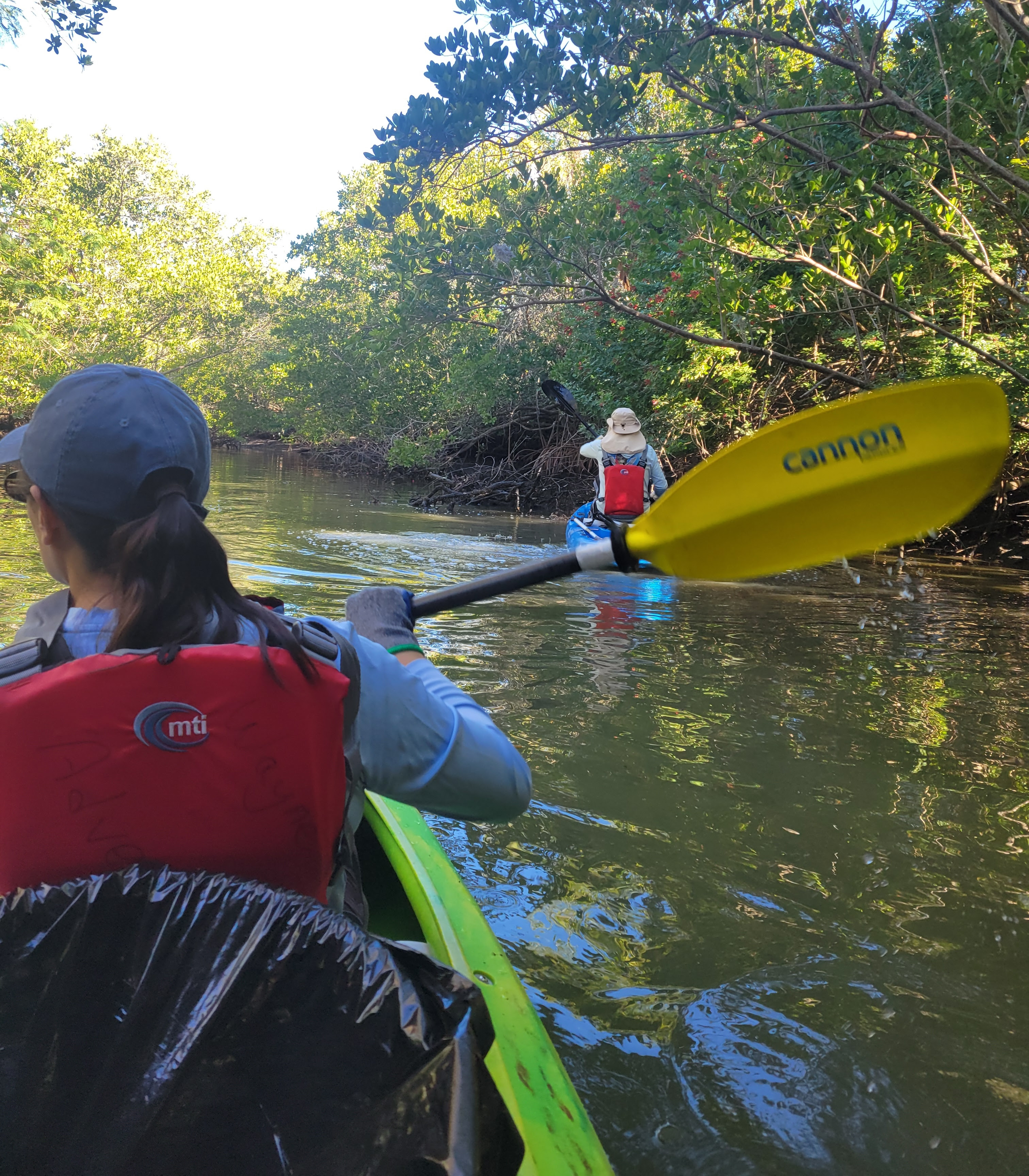
Roll up your sleeves and help remove trash before it reaches our bays and Gulf waters. Cleanups are one of the most direct ways to protect wildlife, improve water quality, and see the difference you make immediately. We'll be at the Honi Hanta Girl Scout Camp in Bradenton working with our local Girl Scout Troop and other volunteers to remove waterside trash from the camp site.
WHEN
Saturday, May 2, 8:30 - 11:30 am
WHERE
Honi Hanta Girl Scout Camp
4825 51st Street East
Bradenton, FL 34203
NEEDED
Kayakers and shoreline helpers
Complimentary lunch for volunteers! Wear protective clothing and shoes. We will be providing gloves and collection supplies, but feel free to bring your own!
|
Mangrove Rangers 2026 Training

Step into one of Florida’s most powerful coastal ecosystems. This hands-on program focuses on mangrove mapping and protection for the third year running. Work with a group of volunteers to perform critical drone mapping of our most valuable, and most vulnerable mangroves.
TRAINING SESSIONS
1760 Mound St, Sarasota, FL 34236
- Sunday, May 3, 1 - 3 pm
- Wednesday, May 6, 6 - 7:30 pm
|
To get involved, send an email to [email protected]
Like we are doing? Join our clean water mission!
https://www.suncoastwaterkeeper.org/
Author