August 2026 Newsletter


|
MONITOR
Stop the Flow of Nitrogen Campaign
Nitrogen pollution remains one of the most pressing issues facing Sarasota Bay. Over 20 years of large stormwater and wastewater infrastructure investments in the 1990s and early 2000s led to critical water quality improvements, cutting nitrogen loads by up to 64% and reversing the bay's nutrient impairment. Seagrasses rebounded, and Sarasota Bay was a success story (1). Today, however, continued development, individual behaviors, and aging infrastructure allow nitrogen to keep entering our waterways.
Stormwater
When rain hits gutters and storm drains, it becomes "stormwater," picking up fertilizers, pet waste, sediment, and yard debris along the way (5). These forms of nitrogen reduce water quality and contribute to algal blooms that can negatively impact our surrounding marine ecosystems and public health (3). Curious about new stormwater regulations? We covered it in our June 2026 Newsletter!
Nitrogen Pollution
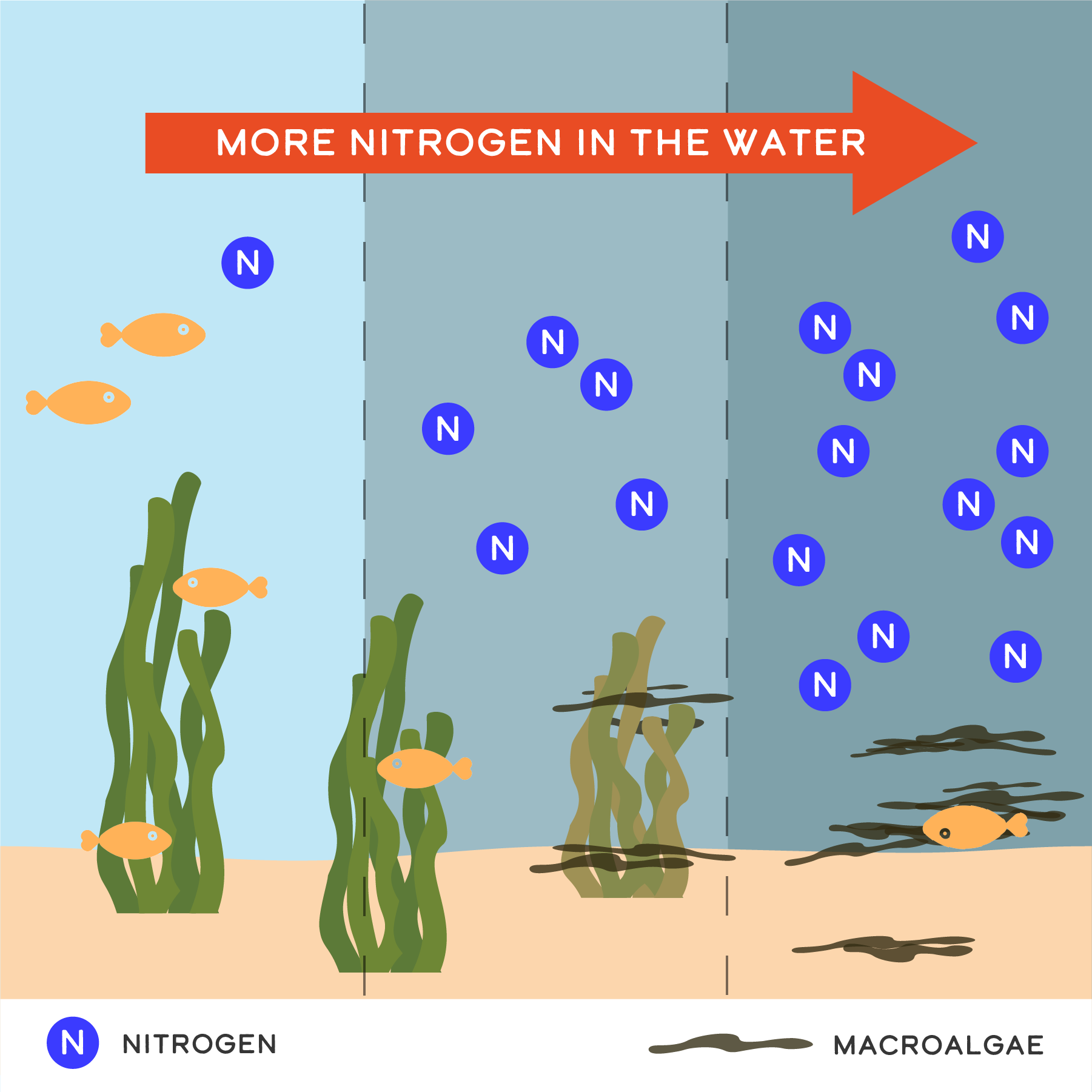
Adapted from Kennish, M.J. (2009).
The graphic above illustrates a simplified example of what happens when too much nitrogen enters marine waters: healthy seagrass beds die off, macroalgae and harmful algal blooms (HABs) take over, and marine wildlife, including the Florida manatees, pay the price, along with our recreation and tourism industries (7, 8).
As residents living and recreating in this watershed, we share responsibility for maintaining a healthy, balanced ecosystem. Managing nitrogen pollution doesn’t just protect the environment; it also protects our health and livelihood.
Suncoast Waterkeeper's Nitrogen Monitoring Program
Since 2021, we've tracked nutrient "hotspots" identified by local partners and scientific advisors to pinpoint where nitrogen pollution originates and where solutions are most needed to improve water quality. We assess these sites against the state's numeric nutrient criteria for West Central Florida streams: an annual geometric mean of 1.65 mg/L for Total Nitrogen (4). Stormwater in the older neighborhoods along the Suncoast is not treated before entering our local waterways. Without a stormwater treatment system like a swale or detention pond, all the pollution rain picks up as it moves to lower elevations ends up directly in the Bay (4, 5).
In 2025, our monitoring found that outfalls along El Conquistador Parkway in Bradenton consistently exceeded state thresholds. We shared this data with Manatee County's Environmental Protection Division, and it became clear that community engagement is currently the only regulatory tool available for nutrient reduction in areas such as these. The County uses storm drain markers to help residents connect neighborhood actions to downstream water quality.
 Credit: Stormwater drain marker examples courtesy of Manatee County Government
Thanks to a grant from the Sarasota Bay Estuary Program and a partnership with Manatee County Government, we're launching the Stop the Flow of Nitrogen Campaign to raise awareness about stormwater pollution and its negative impact on Sarasota Bay. Residents can complete a nitrogen audit to estimate their footprint based on fertilizer use, irrigation, and mowing habits, then take pledges: small, year-round changes to cut nitrogen pollution. Through this, we hope to build a network of Stormwater Ambassadors in neighborhoods upstream of stormwater outfalls.
This September, we're kicking off the campaign at the Estates at Glenn Lakes community in Bradenton. We hope to bring out many homeowners for a meeting where Pia from Suncoast Waterkeeper and Michael from Manatee County Government will introduce the project, share the community's estimated annual nitrogen footprint, and discuss ways to reduce it.
Do you live in one of these neighborhoods?
-
Forest Pines of Manatee Association
-
The Woods at Conquistador
-
Estates at Glenn Lakes Homeowners Association
-
Legend's Cove
-
Legend's Bay
-
Esplanade By The Bay
We want to hear from you! We're looking for a second community to pilot this program. If you think your neighborhood would be a good fit, reach out to Pia at [email protected].
Our monthly monitoring program is still going strong. Peyton is now tracking 14 sites as of August 2026! We're continuing to build baseline data and pinpoint where we can act. Want to support this work? Donate at https://www.suncoastwaterkeeper.org/donate!
References:
-
https://blogs.ifas.ufl.edu/sarasotaco/2023/08/09/water-quality-month/
-
https://www.sciencedirect.com/science/article/pii/S0301479723025999#sec2
-
Kennish, Michael. (2009). Eutrophication of mid-Atlantic coastal bays. Bulletin of the New Jersey Academy of Science. 54. 5-12.
INFORM
Data Centers are Coming. What Will They Mean for Florida's Waters?
A single data center can use millions of gallons of water every day.
As data center development expands across Florida, Waterkeepers Florida is urging local governments to take a closer look at what these facilities could mean for our surface and underground waters, communities, infrastructure, and quality of life.
Data centers require large amounts of water for cooling. Their complex cooling systems can generate wastewater, use chemicals, store diesel fuel, and contain hazardous materials such as heavy metals and PFAS. Spills, leaks, or system failures could contaminate groundwater and surface waters for decades.
Then there is the energy demand. Large data centers can require new power infrastructure and more electricity generation. More generation can mean more water use, putting additional pressure on Florida’s rivers, springs, and aquifers at a time when our freshwater resources are already under strain.
Waterkeepers Florida is calling for temporary moratoriums on new data center applications while local governments study their potential impacts through comprehensive water, noise, and infrastructure impact studies and develop clear, enforceable regulations through a transparent public process.
That means answering basic questions before projects are approved: How much water will they use? Where will that water come from? How will wastewater be handled? What will increased energy demand mean for local water resources? What are the potential impacts on wetlands, wildlife, nearby communities, and local infrastructure?
This is not about opposing technology or responsible growth. It is about making sure communities have the information and protections they need and deserve before making development decisions.
The Suncoast is Taking Action
Sarasota and Manatee Counties have both taken steps to give their communities time to understand the potential impacts of large-scale data centers.
In July, the Manatee County Board of County Commissioners unanimously approved a temporary moratorium on data center development and directed county staff to consider changes to the county’s land development code. Sarasota County has also stopped accepting, reviewing, and approving major data center applications until at least July 2027 while the county studies the issue. Some Sarasota County commissioners have expressed interest in making the restrictions permanent.
We are grateful to both counties for taking a proactive approach. But this issue is bigger than the Suncoast.
Across Florida, communities will have to decide whether they are prepared for proposals that could bring enormous demands for water and electricity. Smaller and more rural communities may have fewer resources to evaluate these projects or develop protections before applications arrive.
Even still, proposals are coming in. In North Port, for example, city staff confirmed that a data center application was submitted on July 20, even with a temporary moratorium in place.
Florida’s water should not be an afterthought in the rush to build. Suncoast Waterkeeper, along with Waterkeepers Florida, is committed to participating constructively in the development of data center regulations to help ensure:
-
Protection of our regional surface and underground waters
-
Strong environmental standards and accountability
-
Meaningful public engagement and transparency
-
Consideration of long-term community and ecological impacts; and
-
Resilient and sustainable planning practices
Read Waterkeepers Florida’s full position statement on data center development.
The City of North Port is holding a Commission Workshop on Data Centers on Thursday, September 3, 2026 at 6:00 PM at the North Port City Hall. Details HERE.
Want to learn more about the potential impacts of Data Center Developments? Check out 1000 Friends of Florida’s Special Report from February 2026
An Update on the Velella Epsilon Fish Farm
The coalition formed in 2023 to oppose Velella Epsilon's offshore finfish farm off the coast of Venice has decided to withdraw from litigation challenging the project. This follows years of contesting Ocean Era's NPDES permit and its many revisions.
Our concerns about the project have not changed. Ocean Era's industrial finfish farm pilot project is an example of a bad aquaculture plan in the wrong place. The farm’s monofilament lines can entangle wildlife, and the project poses real risks to local fisheries. The proposed site is also in hurricane-prone waters, increasing the risk of damage, pollution, and the release of farmed fish that could disrupt local ecosystems. The site is also within a red tide initiation zone, where additional nutrient pollution could contribute to red tide concentrations before moving landward.

Figure 1. Ocean Era’s location for Docket ID EPA-R04-OW-2024-0113 is symbolized with the yellow thumbtack and within the initiation zone of red tide. The satellite imagery shows concentrations of chlorophyll and the dots symbolize the severity of red tide on November 11, 2024.
Meanwhile, recent court rulings and regulatory bias have weakened our legal strategy and made our legal path forward increasingly difficult. We no longer believe that continuing litigation is the most responsible use of our limited resources. Instead, we're redirecting our efforts to monitor the site, track its environmental impacts, and keep our community informed and engaged. If conditions change or new environmental impacts emerge, we'll be prepared to respond, including considering future legal action when appropriate.
Our opposition to this project does not mean we oppose aquaculture. Suncoast Waterkeeper supports responsible aquaculture that produces food and sustains coastal economies without sacrificing the health of our waters and ecosystems. For now, we're focusing on watching this project closely and making sure we're ready to act if needed.
ACT
Thank You to Our Newest Business Partner
Reef Innovations!

Brunch for the Bay 2026 is Moving to the St. Regis Longboat Key!

Mark your calendar! Suncoast Waterkeeper's annual fundraising brunch returns Sunday, November 1, 2026, this year at one of Longboat Key's most stunning waterfront settings. Great food, good drinks, and a room full of people who care about keeping our waters clean.
-
THEME: The Future We Choose: Conservation in a Rapidly Changing Coast
-
WHEN: Sunday, November 1, 2026 | 11 AM – 1 PM
-
WHERE: St. Regis Longboat Key Resort
1601 Gulf of Mexico Dr, Longboat Key, FL 34228
|
Special thanks to the St. Regis Longboat Key Resort for
their generous partnership in hosting this year's event.
Thank you to our Bay Protector Sponsor

Interested in becoming a sponsor? Contact [email protected]
For a Full Listing of Our Events and Ways to Act, Visit Our Events Page.
To get involved, send an email to [email protected]
Like we are doing? Join our clean water mission!
https://www.suncoastwaterkeeper.org/
Author