September 2026 Newsletter


|
MONITOR
Bacteria Concentrations in Palma Sola Bay May Finally Cause Government Action
Recreational water users and residents on Palma Sola Bay have clashed over the years. Waterfront residents have raised concerns with the Bradenton Mayor, the Florida Department of Environmental Protection (FDEP), and the Florida Department of Transportation (FLDOT) about everything from unsafe jet ski rental operations to horse excrement and seagrass loss. Fishermen and anglers have documented declining fish populations and, at one point, dead baitfish in their boat wells. But one question has remained particularly important for people who enter the water: Is Palma Sola Bay safe for swimming?
Since 2022, we have monitored fecal indicator bacteria called enterococci on the northeast side of the Palma Sola Bay causeway where people swim, to help answer this question. Our program was modeled after the Florida Department of Health (FDOH) Healthy Beaches Program. FDOH once monitored the north side of the causeway and, according to Water Atlas data, stopped after 2011. Since we began sampling there, our results show that this part of Palma Sola Bay consistently fails to meet state standards for enterococci.
In fact, the site received the lowest score of all monitored areas across the Suncoast on our annual safe-to-swim report card. In 2024 and 2025, it received an F, with only 45% and 40% of swimmable weeks, respectively. During the same period, FDOH monitored water quality weekly on the southern side of the causeway. Based on the agency’s results, 78% of monitored weeks were swimmable in 2025. Our data on the northeast side of the causeway, coupled with FDOH data on the south side of the causeway, provided enough evidence for the Florida Department of Environmental Protection (FDEP) to recommend adding Palma Sola Bay to the 2026 Verified List of Impaired Waters based on bacteria levels.
But a striking discrepancy remains in how the data are being applied: the beach area north of the causeway, which Suncoast Waterkeeper has monitored for the past five years and where our data have helped identify potential sources of bacterial pollution, will not be designated as impaired.
Why? The data collected by Suncoast Waterkeeper in the north-side swimming area cannot be used to determine impairment for that one-mile stretch of coastline. For that determination, only FDOH data can be used, and FDOH currently has “insufficient data” because the agency just started monitoring it again in January. Yet our data from this same area can be, and have been, used to help determine impairment of the much larger Palma Sola Bay waterbody. The result is a regulatory boundary that does not reflect the reality of the water or the people using it.
What’s more, when FDOH resumed monitoring in January, it returned to the northwest side of the causeway by the fishing pier and pavilions. This area is not known for swimming because a seawall blocks access to the water. As a result, members of the Palma Sola Scenic Highway Byway Organization, which has been monitoring the increased activity on the causeway, have questioned why FDOH is testing off the fishing pier instead of at the beach area, where the public swims.
A comparison of Suncoast Waterkeeper’s data on the north side of the causeway and FDOH’s northside data for July and August shows that the fishing pier location failed to meet Healthy Beaches standards twice, while the swimming area failed six times.
Regardless of these virtual boundaries, if Palma Sola Bay is formally designated as impaired for bacteria, that designation will trigger the next steps in the state and federal water quality process. From November 2026 through April 2027, FDEP is expected to submit its final assessment lists to the U.S. Environmental Protection Agency (EPA) for approval. EPA’s review can take months or, in some cases, years. Once FDEP receives approval, it must develop a Total Maximum Daily Load (TMDL), which establishes the pollutant reductions needed to restore the waterbody. Historically, TMDL development in Florida has taken approximately two to three years.
An impairment designation would therefore mark not the end, but the beginning of a potentially years-long process to identify sources of enterococci, establish the reductions necessary to address them, and ultimately require action to restore Palma Sola Bay. After years of concerns raised by residents, anglers, recreational water users, and advocates, formal impairment could finally provide a clear pathway to identify pollution problems and require solutions.
But the regulatory process cannot become an excuse to overlook the people swimming on the northeast side of the causeway. Regardless of where the state draws its administrative lines, bacteria do not recognize virtual boundaries. Our commitment remains the same: continue monitoring, identify pollution sources, and ensure that the water quality conditions experienced by swimmers on the northeast side of the Palma Sola Causeway are not ignored.
This column was initially published on September 11, 2026 in EcoBeat, a monthly series produced by the Science and Environment Council to bring leading Gulf Coast environmental voices directly to the public. Learn more at http://scienceandenvironment.org/project/ecobeat/
INFORM
For Local Voters, A Chance to Invest in Conservation
This November, Sarasota and Manatee County voters will find separate local conservation measures on their ballots.
Protecting land is one of the most effective ways to protect water. Forests and other undeveloped lands absorb and store stormwater. Wetlands help filter runoff before it reaches our waterways. Conserved land can protect drinking water sources, provide room for floodwaters and preserve habitat as development continues around it.
Suncoast Waterkeeper proudly endorses both local conservation referendums.
Sarasota County Forever
Vote YES and YES for land conservation and parks in Sarasota County
On Tuesday, November 3, Sarasota County voters decide whether to continue one of the most successful land and water protection programs in Florida. The Environmentally Sensitive Lands Protection Program (ESLPP) and Neighborhood Parkland Acquisition Program (NPP) have protected the natural areas, clean water, wildlife habitat, and open spaces that make Sarasota special.
The program protects water quality in our bays, rivers, creeks, and lakes and safeguards our drinking water sources by preserving wetlands, forests, and natural areas that filter runoff, keep pollutants out of Sarasota County’s water supply, and help store floodwaters.
The program has already protected more than 42,000 acres, providing safe habitat for threatened species like Florida scrub-jays, West Indian manatees, and bald eagles, and expanding connections to trails, waterways, and beaches for Sarasota County residents. Sarasota is one of the fastest-growing counties in Florida, so it's essential to continue the program and protect our wildlife and natural places before they are lost to development.
Look for two questions at the end of your ballot:
-
Continue Environmentally Sensitive Lands and Parkland Program Ad Valorem Tax — vote “Yes, for continuation of ad valorem tax”
-
Bond Referendum for the Acquisition and Management of Environmentally Sensitive Lands and Parkland — vote “Yes, for bonds”
You can learn more about the program at sarasotacountyforever.org.
Protect Water, Preserve Land in Manatee County
Vote FOR Bonds to protect water and preserve land in Manatee County
On Tuesday, November 3, Manatee County voters can protect our drinking water sources, the water quality of our bays, rivers, lakes, and creeks, fish and wildlife habitats, and working farms and ranches, while preserving natural areas from overdevelopment and reducing flooding by voting FOR Bonds.
If approved by voters, the referendum will continue and expand the Manatee County Environmental Lands Program by providing additional funds to acquire and protect land with the goal of:
-
Protecting drinking water sources.
-
Protecting water quality of bays, rivers, lakes, and creeks, including the Manatee, Little Manatee, Braden, and Myakka Rivers.
-
Protecting natural areas from overdevelopment.
-
Preserving land to provide natural floodwater storage to help reduce flooding.
-
Protecting working farms and ranches.
-
Creating and expanding public preserves.
In 2020, more than 70% of Manatee County voters approved conservation funding. Those bond funds have now been spent or committed. Continuing the program requires additional bonds and millage to protect more land and ensure that conservation efforts keep pace with the rapid rate of development in Manatee County.
Look for the referendum near the bottom of your ballot:
-
Water Quality Protection, Overdevelopment Prevention, Natural Lands Preservation, and Public Preserves General Obligation Bond Referendum — vote “FOR BONDS”
You can learn more about the program at protectwaterpreserveland.org.

Suncoast Waterkeeper would like to recognize and express our deep gratitude to our newest Legacy Partner, SKT Trust.
Thank you for supporting our work to protect and improve our waters!
ACT
ACTION ALERT: EPA Proposes to Remove Federal Protections for Majority of U.S. Waters

The EPA and Army Corps of Engineers are proposing a major rollback of Clean Water Act protections that could leave 95% of individual wetlands and 79% of rivers and streams in the continental U.S. without federal protection.
The proposal would narrow which waters qualify as “waters of the United States,” or WOTUS. Many seasonal streams and wetlands without a continuous surface water connection could lose federal protections from pollution and destruction.
The vast majority of Florida’s wetlands are seasonally driven by rain and regional groundwater. A wetland that looks isolated in the dry season can connect with downstream waters during the wet season. The proposal would therefore withdraw protection from wetlands not because they lack meaningful hydrologic, chemical, or biological relationships with downstream waters, but because those relationships are not continuously visible at the surface. That result is neither scientifically defensible nor consistent with the Clean Water Act’s purpose.
We’re joining Waterkeeper Alliance in calling for strong Clean Water Act protections.
Use Your Voice and Leave a Comment Before October 9 at: https://waterkeeper.quorum.us/campaign/DID-WOTUS-Sept26/
Environmental Protection Agency Fact Sheet: https://www.epa.gov/system/files/documents/2026-09/wotus_snprm_factsheet_508c.pdf
Brunch for the Bay 2026 is More than Halfway Sold Out!

Join us at the St. Regis Longboat Key Resort for Brunch for the Bay 2026, Suncoast Waterkeeper’s annual celebration of clean water and the people working to protect it. This year, we’re excited to bring Brunch for the Bay to one of the Suncoast’s newest waterfront destinations, with a beautiful setting overlooking the Gulf.
This year’s theme, The Future We Choose: Conservation in a Rapidly Changing Coast, will explore the choices we make today to protect the lands and waters that make the Suncoast worth calling home. We’ll hear from keynote speaker Carlton Ward Jr., conservation photographer, Emmy Award-winning filmmaker and National Geographic Explorer, whose work has helped tell the story of Florida’s wild places and the need to protect them.
Come enjoy brunch, take in the waterfront setting and help sustain Suncoast Waterkeeper’s work throughout Sarasota and Manatee counties.
-
WHEN: Sunday, November 1, 2026 | 11 AM – 1 PM
-
WHERE: St. Regis Longboat Key Resort
1601 Gulf of Mexico Dr, Longboat Key, FL 34228
|
Special thanks to the St. Regis Longboat Key Resort for
their generous partnership in hosting this year's event.
THANK YOU TO OUR SPONSORS
LEGACY PARTNER
Patricia L. Chapman, on behalf of The Glenridge Green Team
BAY PROTECTORS
City of Holmes Beach
Clean Water Committee


SEAGRASS STEWARD
Beachside Management
Whistanfox LLC
Interested in Becoming a Sponsor? Learn More HERE
Join Suncoast Waterkeeper's Captains Club!
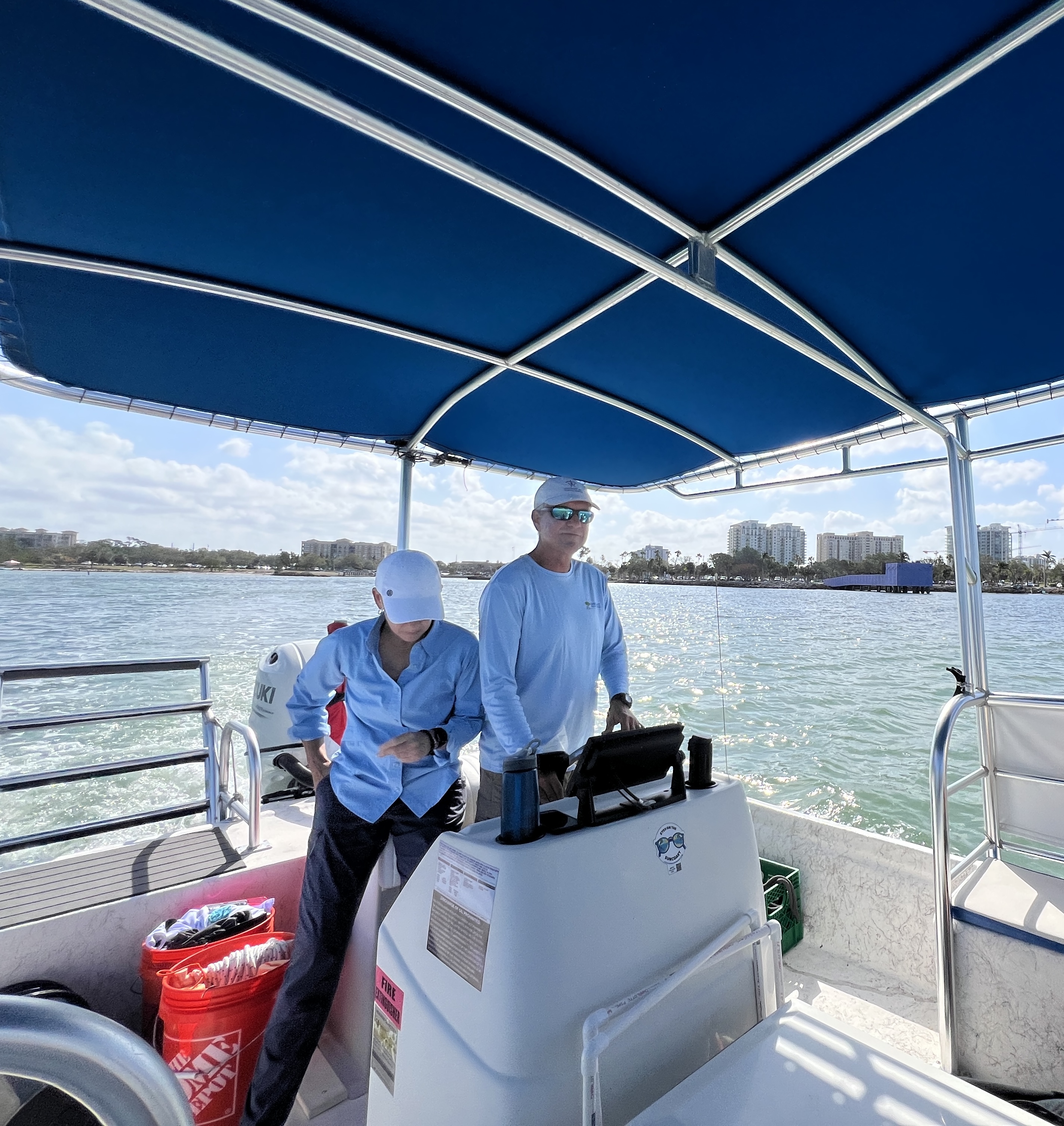
Love being on the water? Put your skills to work for clean water on the Suncoast!
Suncoast Waterkeeper is looking for licensed captains to help get our team out on the water for clean water patrols and monitoring aboard our 25-foot Slayer Skiff.
Join our new Captains Club by registering and sharing your availability. When we need a captain and schedules align, we’ll reach out to get you on the water with our team.
What You Get:
-
Per diem compensation from Suncoast Waterkeeper
-
Suncoast Waterkeeper SPF shirt and hat
-
Time on the water while supporting local water quality monitoring and clean water work
Interested? Sign up for the Captains Club and let us know your availability.
Calling All Dock-Owners: Help Us Keep Monitoring!

We’d like to express our deep appreciation for James Haft, who is kindly letting us use his lift for the summer! Thanks also to the enormous generosity of the Bahia Mar West Marina and the owners’ commitment to clean water; the Suncoast Waterkeeper Patrol Boat has had a safe and well-cared-for home over the years.
Suncoast Waterkeeper is looking for a lift for our 25-ft Slayer Skiff that helps us monitor water quality, investigate pollution sources, and patrol our bays. Keeping our boat on a lift will improve our access to the water, allowing us to get out more often.
Here's the thing: Every day this boat is out on the water is a day we're collecting critical data, spotting problems before they get worse, and protecting the waters you love.
Can you help us? Do you have dock space available, or know someone who might be willing to rent their lift? We'd love to chat about making this work!
Any leads? Contact Abbey Tyrna, Waterkeeper & Executive Director (executivedirector@suncoastwaterkeeper.org)
Make a Splash with a Tax-Smart Gift
Did you know you can protect our local waterways and save on your taxes at the same time? If you are 70½ or older, you can donate directly to Suncoast Waterkeeper from your Traditional IRA using a Qualified Charitable Distribution (QCD).
Why it’s a win-win:
-
100% Tax-Free: The transfer goes directly to us, meaning you pay zero income tax on the distribution, even if you don't itemize.
-
Satisfies your RMD: If you are 73 or older, a QCD counts toward your Required Minimum Distribution, helping you avoid a higher tax bracket.
How to do it:
-
Contact your IRA custodian and request a "Qualified Charitable Distribution" form.
-
Direct the gift to Suncoast Waterkeeper, Inc.
-
Drop us a line at [email protected] to let us know it's coming, as custodian checks often arrive without donor names!
Tip: The check must be made payable directly to Suncoast Waterkeeper to qualify for the tax benefit. Consult your financial advisor to see how a QCD fits your goals.
For a Full Listing of Our Events and Ways to Act, Visit Our Events Page.
To get involved, send an email to [email protected]
Like we are doing? Join our clean water mission!
https://www.suncoastwaterkeeper.org/
Author