Our Expertise
Suncoast Waterkeeper adopts the same standard operating procedures (SOPs) and National Environmental Laboratory Accreditation Program Certified (NELAC) lab as local government agencies.
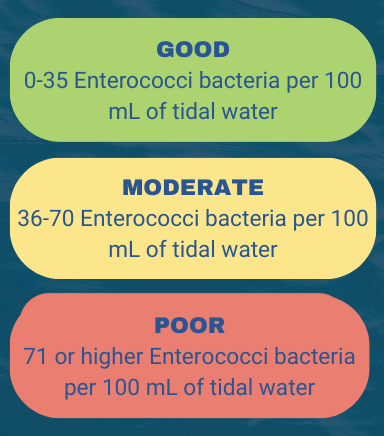
We also use the Florida Department of Health's Healthy Beaches water quality categories to assess swimming safety on the Suncoast, as seen below. A location is considered safe for swimming if it doesn't fall within the "Poor" water quality category. Results of 71 or higher are considered unsafe, as epidemiological studies show a heightened risk of contracting a bacteria-related illness (32 out of every 10,000 swimmers) at this level of water contact.
Every week, we email local and state government agencies with the enterococci results. In a recent effort to reach a wider audience, including state institutions, we began sharing our results in additional databases, like the Watershed Information Network (WIN) of FDEP and the USF Water Atlas Recreational Water Quality Map for Tampa Bay, Sarasota Bay, and the Coastal & Heartland National Estuary Partnership.
Water quality standards are used to determine swimmability, with sites graded annually from A to F based on their percentage of swimmable weeks. The swimmability grade is based on how many weeks each monitored location is considered safe for swimming each year. The percentage of “swimmable” weeks is then calculated and used to determine the grade. Enterococci results between 0 to 70 #/100 mL are considered swimmable, while results greater than 71 #/100 mL are considered unsafe for swimming.
We are concerned about swimmability because our monitored locations are popular for a variety of recreational activities, including swimming, wading, kayaking, fishing, boating, and windsurfing. They are considered Class II or Class III waterbodies and therefore must meet the Florida Department of Environmental Protection's criteria for Enterococci bacteria for their designated use.